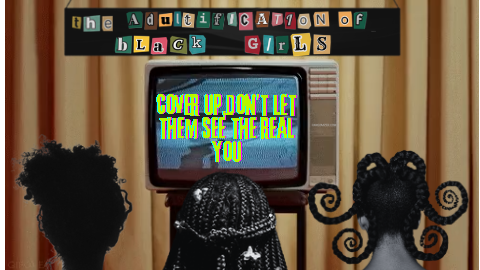
The Adultification of Black Girls – The Grown Black Girl Phenomenon
What Your about to read
Many women of all shades of brown have experienced adultification bias. Whether it be in school or with family, and even with strangers. It can start early and sometimes before a child has reached elementary school. Simply put, It’s the view that Black girls are less innocent and more adult-like than their white peers
Research groups like The Georgetown Law Center on Poverty and Inequality have worked hard to uncover whether there is an adultification bias towards black girls, and what they found is shocking.
In this article we are going to take a peak at history, media, and the studies relating to the adultification bias especially when it pertain to women and children. While revealing where it possibly started, how it’s changed, and why it shouldn’t exist at all.
A broader definition
The adultification bias is a stereotype based on the ways in which adults perceive children and their childlike behavior.
It is clear that the bias is primarily directed toward black children and girls but can also be put towards all different kinds of children of color.
It’s the perception of Black girls as older and less innocent than their white peers.
Adultification bias is a unique form of intersectional bias against Black girls — rooted in a combination of their sex, age, and race.
This bias presents itself in households, education, and in a society where Black children are expected to act like adults before reaching adulthood, by the adults they interact with; family members, strangers, teachers, and police officers
Adultification bias leads to children of minority groups being treated as if they are maturer than they actually are based on social standards and therefore less deserving of help and is a form of racial prejudice.
The Adultification Bias In History
When you take a look at history and specifically the way Black girls have been treated throughout it’s clear that the adultification of young black girls was not a mistake.
The adultification of young Black girls remains a deeply rooted social problem with damaging ramifications.
Much like theories for segregation, this concept dates back to African enslavement when children as young as 2 or 3 were put to work as adults and punished for exhibiting age-appropriate behaviors.
Treating Black children as adults gave license for their punishments to be more severe, and therefore excused racist abuses. Enslaved Black girls were frequently raped by white owners with impunity, often forced into sexual relationships for breeding purposes.
This was used to break their will and solidify white supremacy. There is a long history of violence against Black girls and women without fanfare or consequence.
During legal enslavement (1776–1865), Black women were raped, beaten, and expected to be wet nurses. There was little autonomy over their bodies, and objectification was expected.
While white women, as a category, were portrayed as models of self-respect, self-control, and modesty – even sexual purity, but black women were often portrayed as innately promiscuous, even predatory. This depiction of black women is signified by the name Jezebel

The portrayal of black women as lascivious by nature is an enduring stereotype. The descriptive words associated with this stereotype are singular in their focus: seductive, alluring, worldly, beguiling, tempting, and lewd.
This was extremely present during The Jim Crow Era (1877 – 1964)
During this time period, black women had been stereotyped as the “jezebel” (naturally hypersexual, promiscuous,), the “sapphire” (angry and emasculating), or as the “mammy” (motherlike, asexual, and nurturing).

Although the Mammy caricature was also a dominant popular cultural image of black women from slavery to the 1950s, the depiction of black women as Jezebels was common in American material culture.
Everyday items – such as ashtrays, postcards, sheet music, fishing lures, drinking glasses, and so forth – depicted naked or scantily dressed black women, lacking modesty and sexual restraint.
So the thought of Black women and girls brought up a skewed image of scandalous and angry women and that the word black and lewd were synonymous. Of course this notion wasn’t true but this way of thinking of Black women and girls became engrained in society’s hive mind.
Modern Day and Media
But let’s face it, It’s not the 1950s anymore, so how does this affect women and girls today?
These historical perceptions have had long-term effects on self-esteem, mental health, and safety of young black children of today. Derogatory terms like “fast” follow Black girls into classrooms, communities, and media depictions, where they are often viewed as adults before their time
A dance or item of clothing that may be innocent on another individual would become “grown” or “fast” once associated with a black girl but why was this? I have now come to understand these experiences as a result of the adultification of black girls.
The terms “fast” and “hoochie” are also emblematic of this problem. It implies that a girl is seeking sexual attention, reinforcing harmful stereotypes about Black femininity. These labels aren’t just words—they’re burdens.
One of the oldest examples of the jezebel trope in film goes back to The Birth of a Nation, with
the biracial character Lydia Brown characterized as “savage, corrupt, lascivious, and overtly
sexual,” using, “her ‘feminine wiles’ to deceive the formerly good white man
Tropes such as this one can be regarded as one of the most detrimental to Black women. Painting Black women as jezebels has, since slavery times, been a tactic of the white man, used to defend their heinous actions towards female slaves. Today, it is still used to justify cases of sexual assault against Black women (George-Ballard).
As a result of this Jezebel stereotype, Black women are held accountable for the actions of their abusers, and even face difficulty being believed when they come forward
When it comes to movies and tv shows from the last 20 years up until 2021 I rarely encountered depictions of Black girls in television shows that didn’t portray us as angry, manly, overweight, overly sexual, or asexual caregivers, with few exceptions.
These messages force us to constantly fight against them or succumb to what is expected and enforce the idea that Black women and girls can handle abuse.
These messages allow state sanctioned violence against Black girls and women to go unchecked.
What do the studies say?
As of 2017 Black women are more likely to experience sexual violence, abuse in their relationships, or be killed by a partner. “The Institute for women policy research”
One in four Black girls will experience sexual abuse before the age of 18 “The SAFE Allience”
Black children have been 18 times more likely than White children to be sentenced as adults rather than children (Poe-Yamagata & Jones, 2007).
Likewise, in education, Black children are substantially more likely to be suspended from school (Riddle & Sinclair, 2019) or receive harsher punishments for the same infractions (Okonofua & Eberhardt, 2015) than White children
A National Women’s Law Center’s report “concluded that dress code policy enforcement unfairly targeted black girls” which is an experience that I frequently experienced and bore witness to in my middle and high school years. All this does is teach young Black girls that, “every part of black girlhood —from their hair to their bodies and attire— has the potential to be penalized.”
Lastly, The George Town Law Center of Poverty and Equality conducted a survey in 2017 and found that survey participants perceive compared to white girls of the same age
- Black Girls need less protection
- Black Girls need less nurturing
- Black Girls know more about sex
- Black Girls need to be supported less
Now that you know about the history and the way the media continues to portray black women and girls. These findings don’t seem as surprising right?
Conclusion
I believe 5 things need to happen to stop and work against the identification bias that young black children receive
- Adults need to stop blaming girls for their natural biological changes.
- Adults need to be aware of the adultification bias and why it’s harmful to children
- Parents need to adopt a child first policy
- Adults need to avoid using adult language when referring to children
- Parents need to understand behaviors instead of mislabeling them
This won’t get rid of the problem entirely but progress is better than continuing to let this affect the young children in communities around the world.
Be the change that these children deserve, Share this with you fellow adults and help bring a stop to the adultification of black girls.
Links to studies
Girlhood Interrupted: The Erasure of Black Girls’ Childhood
Research World – The Adultification of Black girls
IWPR – Violence Against Black Women – Many Types, Far-reaching Effects