The Black Influence on Modern Day Nail Culture
The Real Origins
The use of fake nails can be traced all the way back to ancient civilizations. In Egypt, in 3000 BC both men and women used bone, gold and ivory to create artificial nails and henna to dye them.
This trend was especially prevalent among the pharaohs and their families, who were known for their affluence and extravagance.
In ancient China during the Ming and Qing dynasties, nail guards or hu zhi, literally “finger covering,” were used as protectors and accessories by upper class women, and became popular decorations.
Usually made from metal, shells, and even jade, these curved, talon-like objects were decorated with various designs.

These nail guards were mostly worn on the ring finger or little finger by women of the imperial court to show their high status as long nails were a sign of being exempt from manual labor.
In early 19th century Greece, upper-class women often wore empty pistachio shells or used paper adhesives over their nails, slowly spreading the artificial nail trend across Europe.
Around the late 19th and 20th century nail manicures and nail polish became popular.
This was mostly something that was done at home as U.S nail salons were a rare commodity.
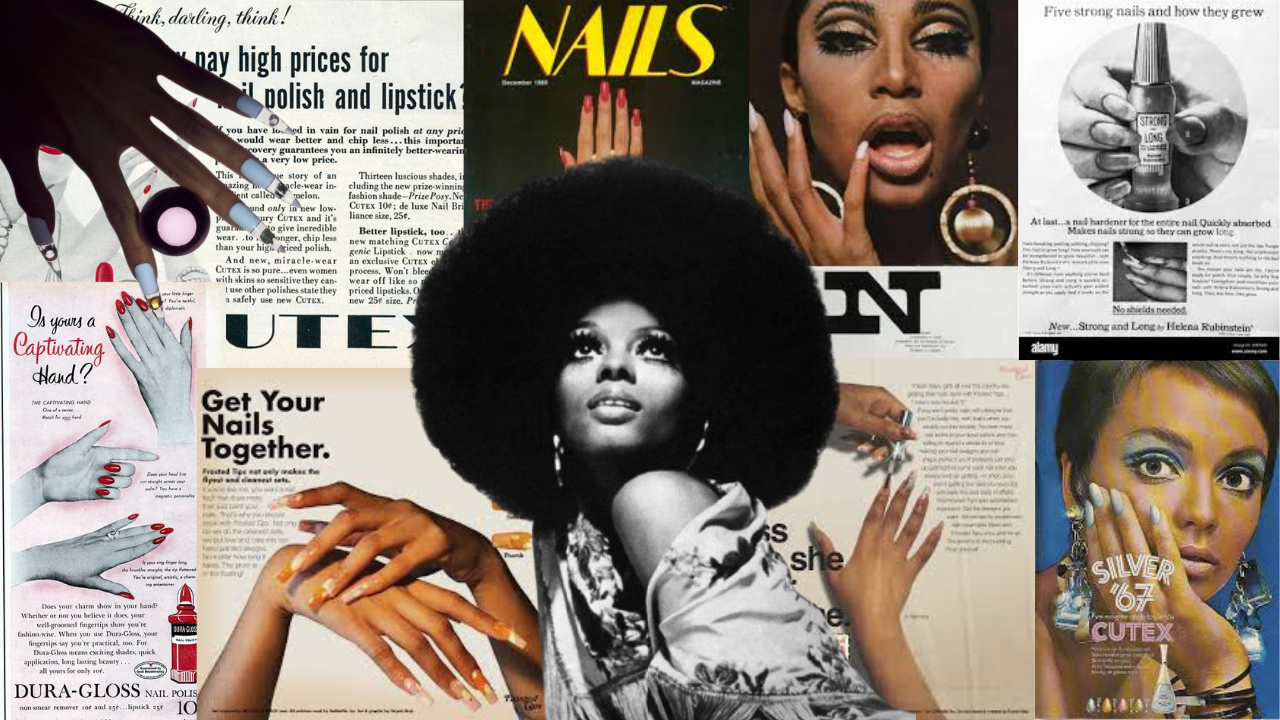
In the 1930’s-1950’s with nail magazines encouraging women at home to do their nails as a step in their beauty routine simple nail colors started to emerge with brands like Revlon having matching lipsticks and nail polish featured in magazines gaining mass popularity.
These styles were swiftly adopted by Black women as a sign of femininity and style. Donyale Luna, the first Black woman on the cover of Vogue in 1966, was wearing acrylic Red nail lacquer.

So who invented acrylics?
Did you know a dentist is behind the invention of the acrylic nail? That’s right it wasn’t someone in the beauty industry it was all because of a dentist.
In 1954, Frederick Slack, a dentist from Philadelphia, was having a regular day at work. That is until he accidentally broke one of his nails during a dental procedure.
Using his expertise in dental materials, he used dental acrylic, an innovative material at the time, to create a makeshift cover for his broken nail. Not only did this acrylic nail cover the broken area perfectly, but it also looked surprisingly natural and durable
What started as a solution to a personal problem could actually be the next big thing in beauty.
Frederick Slack wasn’t content with just a single acrylic nail on his own finger. He saw an opportunity to take his discovery to the masses. Working with his brother, Tom Slack, Frederick began refining the technique and materials, aiming to create a commercial product that could be used by women everywhere.
They developed a process that involved sculpting nails using the same dental acrylics but designed specifically for cosmetic use
Back then, nail art was supposed to be all about nude colors and French tip designs — no bright colors and certainly nothing long
Black women were criticized by media outlets for their nail art designs that did not conform with what white America perceived as “appropriate.
These attitudes continued well into the 1970s and 80s, as Black women adopted acrylic nails. Society — that is to say, middle-class white society — sneered at “fake” nails and considered them a sign of being low-class. After all, if you couldn’t grow your own nails long enough to paint, that must be because you were working class.
During the 1970s, nail art became synonymous with the disco era; singers like Donna Summer and Diana Ross had “long, red, square-shaped acrylics bedecked with twinkling rhinestones
The creation of Vietnamese nail salons
Today, Vietnamese Americans own and operate approximately 50% to 80% of all nail salons in the U.S, but why is that?
In 1975, Tippi Hedren was doing humanitarian work. She was running a program for 20 Vietnamese refugee women to resettle them in the U.S. They admired her nails, the care that she took, and she got the idea to get her personal manicurist, Dusty Coots, to come to the refugee camp in Northern California and teach these women how to do a manicure as it would be done in Beverly Hills.
This decision would go on to empower these women, equipping them with a valuable skill that would not only provide financial independence but also open doors to entrepreneurship. The ripple effect of this training spread throughout the refugee community, helping many establish successful careers in the nail care industry.
Black Influence on Modern Day nail Trends
Donyale Luna was the first Black model to appear on the cover of the British edition of Vogue, in March 1966 showing her long colored nails. She even went on to be called the first Black supermodel.
In the 1980s, Florence Griffith-Joyner (a former nail tech herself) won Olympic gold brandishing six-inch multicolor nails — a fact mentioned more often than her athletic prowess. Time and again, articles about Griffith-Joyner fixated on her dazzling claws, cheekily painted to match her running gear and her medals.
La Toya Jackson and Flo Jo both wore intricate nail designs throughout the ’80s and in the ’90s, music legends like Missy Elliott and Lil’ Kim started a new cultural wave with nail art that can still be seen today
Nail art flourished and evolved in Black culture throughout the 1990s and 2000s, thanks in no small part to rappers like Missy Elliott and Lil Kim rocking acrylics. From there, it was a short, if all-too-familiar, path to cultural appropriation and mainstream adoption.
Nail influencers have tens of thousands of followers on Instagram, nail techs like Jenny Bui are stylists to celebrities, but none of it would’ve been possible without the pioneering Black women who chose their own beauty path and created an unforgettable style.

conclusion
Nail art has been popular for centuries for a number of reasons, wealth, status, individuality, and a way to make a living with the help of the dentist’s happy accident and the rise of nail shops pioneered by Vietnamese owners.
It was a mixed effort but black culture had an influence in the rise of popularity after the 70’s nail art rose to worldwide fame, with famous artists like Lil Kim showing creative new ways to wear acrylics.
But what was once a sign of status and wealth quickly became another way for white Americans to tear down the black community and use it as a sign of low class.
While Black women are slowly, but surely gaining recognition for their contributions and integral roles in the nail art movement, there’s still a lot of progress to be made
Now people from all cultures and backgrounds wear acrylics. It’s important to understand its origins and who helped make it popular.