The Tulsa Race Massacre: A Calculated Attack on Black Wall Street
overview
The Tulsa Race Massacre was a horrific display of race based violence, becoming one of the most deadly massacres in U.S history. This bloody 1921 outbreak in Tulsa has continued to haunt Oklahomans for decades.
BEfore the massacre
By early 1921 during the Jim Crow Era, Tulsa was a modern city with a population of more than one hundred thousand. It had a thriving oil industry giving it the name “The oil Capital of the world”. While still segregated, most of the city’s African American population lived in the Greenwood District, 10,000 people lived in this vibrant neighborhood that was home to two newspapers, several churches, and hundreds of Black-owned businesses.
The people of Greenwood made their own community and thrived. Greenwood was often referred to as Negro Wall Street for their success.

However, Tulsa was still a dangerous place to be, especially as an African American.
the start of the massacre
On May 30 1921, a Black teenager named Dick Rowland entered an elevator at the Drexel Building, an office building on South Main Street. At some point after that the young white elevator operator, Sarah Page.
A brief investigation took place shortly after, and Page told police that Rowland had merely grabbed her arm and that she would not press charges. He was subsequently let go
Then a front page article in the Tulsa Tribune falsely reported that Rowland sexually assaulted Sarah Page.

The next morning the police arrested Rowland and held him again for questioning.
As the rumors spread throughout the neighboring white communities, an angry white mob of around 50 began gathering outside the courthouse, demanding the sheriff hand over Rowland. Sheriff Willard McCullough refused, and his men barricaded the top floor to protect the Black teenager
Black men including WW1 veterans from the town quickly gathered at the Tulsa County Courthouse after Rowland’s arrest to protect him from being lynched. They were turned away by the Sheriff
The first shots were insured by a police officer attempting to disarm one of the black men, killing him.
The News helped incite violence claiming a lynching was going to happen, and making false claims of an insurrection.
The black men were forced to retreat to Greenwood and when they came back around 10pm with a group of 75, there were around 1,500 angry white men waiting.
Unfortunately the mob followed and within hours hysteria grew and thousands of white mobs poured into greenwood.
They moved Rowland to a safe place and refused to give up his whereabouts
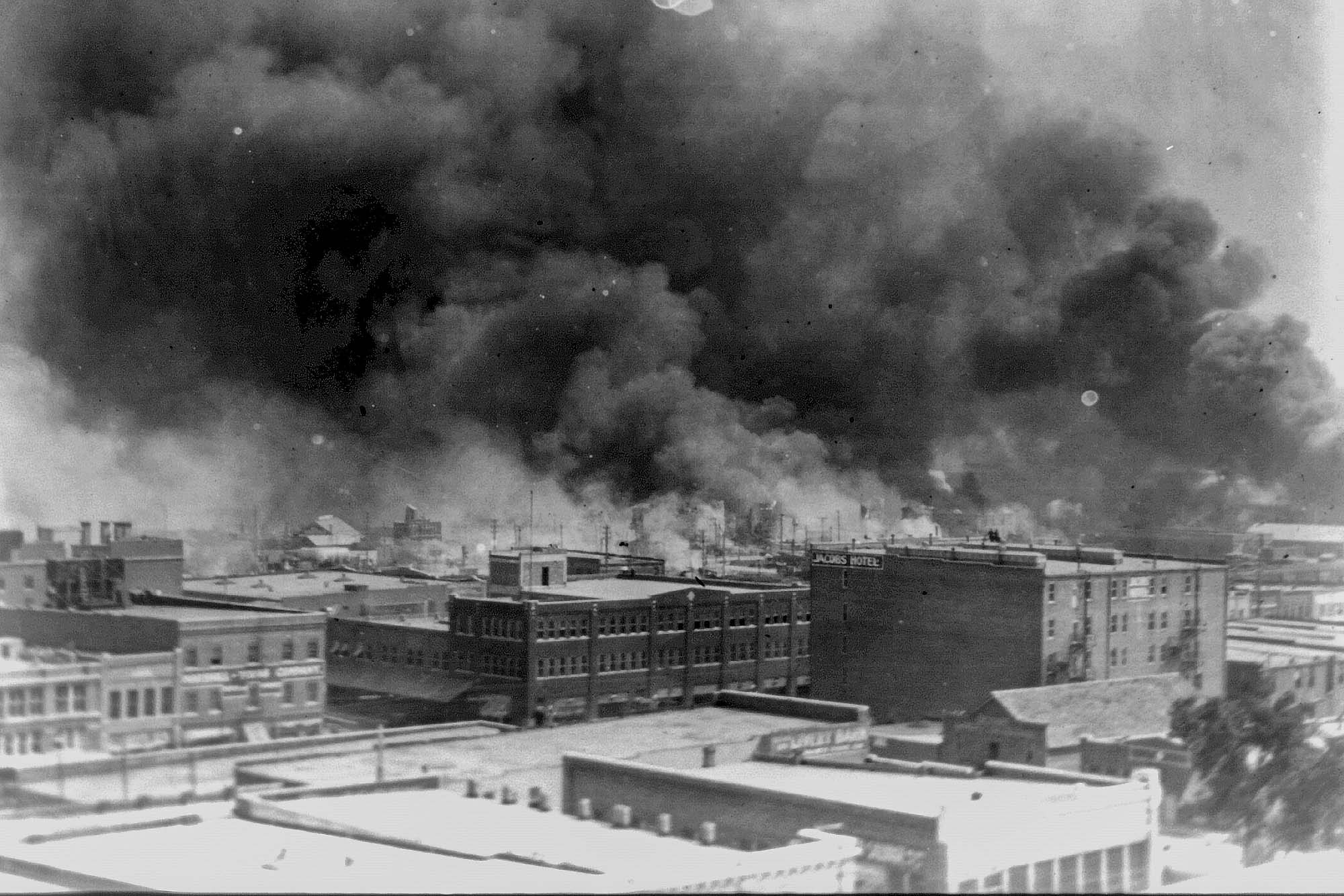
Over the next morning on June 1st, the mob began to destroy the town, burning businesses and homes across the city. Firefighters who tried to help were met with an angry mob and forced to leave.
The police then armed over 500 white civilians naming them special deputies and giving out badges. According to the Oklahoma Historical Society, some in the mob were instructed to “get a gun and get a n—–”.
By the time Governor J. B. A. Robertson had declared martial law the massacre had already ceased. Leaving the town of Greenwood in aches. According to a later Red Cross estimate, around 1,256 houses were burned; 215 others were looted but not torched. Schools. churches and hospitals were also destroyed.
After the massacre

The police arrested 6,000 Black Americans containing them on a fairground, later forcing them to clean the remnants of the town they used to live in.
After the massacre Rowland was safely released and assumed not guilty as it was clear he just accidentally stepped on her shoe causing her to scream.
Rowland immediately left town and never returned.
There were an estimated 10,000 African Americans left homeless that were later housed in internment camps.
The Red Cross with the help of volunteers helped thousands of the unhoused. Providing them with food, water, and shelter. They set up hospitals for the injured and provided medical assistance like vaccinations to those in need.
With no where to go and their community destroyed many previous residents of Greenwood were forced to live in tents.

It was clear the police attempted to cover up what had happened that day. They got rid of case files and police reports. Due to how much evidence was scrubbed many people doubted the realness of the events, some even claiming it didn’t happen.
A state commission was formed in 1997 to investigate. The report recommended that reparations be paid to the remaining Black survivors. Although no reparations were ever given to the victims of the massacre.
Despite overwhelming evidence, no whites were ever sent to prison for the murders and arson that occurred.
final words
It’s no secret what happened in Greenwood was a tragedy. What the residents lost that day they could never be given back.
It does beg the question, what if the newspaper articles never got published? How many people’s lives could’ve been saved that day?